- In recent years, the urbanization process in Vietnamese cities has been taking place at a great pace, especially in big cities. That is creating a great pressure on urban technical infrastructure. The demand for developing and expanding new pipeline networks as well as improving old ones has been increasing.
GENERAL INTRODUCTION

- Currently, most of the new installation, repair and improvement of technical infrastructure pipelines are being carried out by the traditional open-digging method. With this construction method, excavation and reconstruction of old roads with high traffic density must be carried out, causing great waste, seriously affecting the traveling of vehicles and causing loss of urban beauty. , affect the environment.
- On the other hand, the method of open excavation is limited, it is difficult to install or renovate the existing pipe sections with great deep burial, weak geological conditions, ground clearance, relocation of underground technical infrastructure. other techniques ... thereby extending the construction schedule, increasing the total investment, even stopping the project completely.
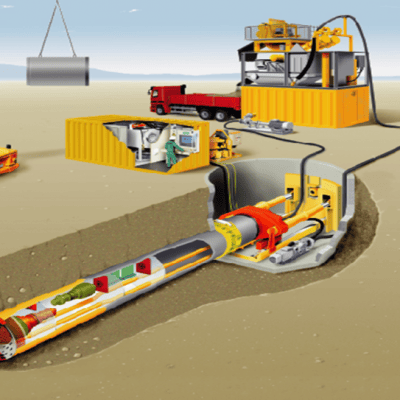
- Due to the above limitations of open excavation methods, countries have applied the method of no-dig construction: underground excavation in the construction of new pipelines and on-site repair methods to renovate the existing infrastructure pipelines.
- In the field of pipe rehabilitation and restoration, there are many different methods of non-digging such as Sliplining, Softlining, Lining (Relining), Pipe-Reining (Re-rounder), Pipe breaking ( Pipe-Cracking, Compact Pipe, Welding of liquid solutions and in-place pipe lining technology (CIPP).
- Each of the above construction methods has different application conditions, depending on the shape of the pipe (round, arch ...), the type of pipe (concrete, cast iron, steel ...) and the type of pipe (water supply, drainage water, oil lead, ...). And in that, the in-place lining technology can meet the above conditions.
CUTTING IN-PLATE TECHNOLOGY - CIPP (CURED-IN-PLACE PIPE)
1. Technology process:
- Damaged pipes (cracked or broken) will be repaired by putting in a layer of Poly Vinyl which is able to stick to the old wall and bottom of the sewer and restore the bearing capacity of the sewer line.
- Lining can be produced in any shape of a cross-section (round or arch) consisting of one or more layers of fiberglass reinforced with plastic-reinforced Poly-Vinyl compound which has hardening properties. when exposed to ultraviolet rays. Therefore this technology is called the "in-place pipe lining" technology - CIPP (Cured-In-Place Pipe).
2. Advantages
- Absolutely no digging the road, only use the existing manholes to repair, quick repair time, does not obstruct traffic.
- Due to no digging, there is no need to survey and relocate underground constructions.
- The thickness of the reinforcement layer is thin, less reducing the cross-section of the pipe, moreover because the surface of the reinforcement layer is smooth, smooth, the roughness coefficient is smaller than the surface of the old material layer so it does not reduce the drainage flow .
- Reduce pipe maintenance costs in the following years.
3. Applicability
- Type of pipe: drainage, water supply, oil conduction, ...
- Shape of tube: round, arch.
- Tube material: concrete, brick, cast iron, steel, ...
4. The length of construction depends on the length of the pipe section, the distance between the two manholes, the length of each construction stage is
- For pipes with diameter ≤ D 800: length of about 200m.
- For pipes with a diameter> D 800: the length is about 150m.
TEXTILE FIBER SHEET PLATE
1. Structure
- The lining consists of one or more layers of fiberglass or specialized cloth covered with poly-vinyl plastic compound that hardens when exposed to ultraviolet radiation. The liner thickness can reach 15mm
2. Specifications
- Tensile Strength 2000 ÷ 3000 psi = 14 ÷ 20 MPa
- Flexural stress (3500 ÷ 4500 psi = 24 ÷ 31 MPa)
- Flexural modulus of elasticity 200000 psi = 1379 MPa
a. Plastic
- Depending on the type and material of the repair pipe, the appropriate plastic will be used. Compounds covering glass fiber lining usually include 03 types:
- Vinyl Ester: is the product of the reaction process of epoxy resin with methacrylic acid and formed from unsaturated reaction at the end of the molecular chain. The resin is mixed with a reactive styrene monomer and reacts with the activator to form a copolymers bond.
- Vinyl Ester is often used when repairing industrial sewage pipes, pipes subject to corrosion or high pressure.
- Polyester resin: Polyester plastic is a product of the reaction between isophthalic acid / terathalic acid, maleic anhydride, and 1 type of glycol, with unsaturated reaction characteristics located along the molecular chain. The resin is mixed with a reactive styrene monomer and reacts with the activator to form a copolymers bond. Polyester resins are commonly used for a variety of pipes.
- Epoxy resin: popularly used for many types of industrial water pipes or clean water pipes, high pressure or heat resistant pipes.
b. Fiberglass: Fiberglass (Fiberglass)
c. Coating: Polyethylene, PVC, Urethane
CONSTRUCTION OF GLASS FIBER PIPE PIPE (Tube Liner)
1. Update construction route information and survey routes
a. Update construction route information: Information related to the construction route should be updated in detail and aggregated into a report file.
b. Surveying the construction route: The information related to the construction route will be fully and accurately surveyed to compare with the updated data. This survey is carried out in combination with CCTV survey vehicles and actual measurement and survey work.
c. Processing updated data: The whole process of updating information and surveys will
to be performed before construction and continuously during the construction process to give: figures for the production of Liner pipes (pipe diameter, length of each pipe section, pipe thickness, pipe material layers, etc.) . Methods of construction, reasonable construction arrangement for each segment, construction line.
2. Executing and installing fiberglass pipe: Including 05 steps
a. Checking the sewers and preparing construction:
- Checking the sewers: Use CCTV vehicles to check the sewers before construction and record the whole situation with paper and image files.
- All inspection reports in paper and image files should be adequately, clearly and clearly identifiable.
- Construction preparation: Fully check equipment, machinery, control parts and auxiliary equipment. Check the liner ...
b. Sanitation of sewer beds:
- Use high pressure washer, clean the sewer before construction and check again by CCTV.
- All inspection reports in paper and image files should be adequately, clearly and clearly identifiable.
c. Construction and installation of Liner pipe:
- The impregnated fiberglass sheet that was pulled into the section to be repaired has been cleaned.
- Use compressed air to stretch the fiberglass sheet to cover the inner surface of the old pipe and use ultraviolet (UV) to dry, forming a tight coating, resistant to corrosion.
- Handling existing pipe joints by circuit breaker and finishing inspection by CCTV system
d. Handling existing pipe crossings with a drill drill.
e. Complete inspection by CCTV system.
SOME PICTURES AFTER THE CIPP CONSTRUCTION
SITUATION OF INVESTMENT AND APPLICATION OF PIPE PIPE TECHNOLOGY IN TP. HCM
- On-site lining technology is an advanced technology in the world, not yet applied in Vietnam; In 2008, the Urban Drainage Company was assigned by the Ho Chi Minh City People's Committee the investor of the project "Procurement of pipe repair equipment with pipe lining technology" to prepare for the implementation of restoration works and repairing damaged, old and degraded water supply and drainage pipes in Ho Chi Minh City. Ho Chi Minh.
- A pipe lining factory was built in Nhi Xuan Industrial Zone - TP. Ho Chi Minh according to German technology: manufacturing fiberglass pipe pads suitable for size and shape of pipes.
- Construction equipment at the field installed on trucks: imported, trained and transferred technology from leading German companies.
- On 09/04/2011 Urban Drainage One Member Co., Ltd was assigned by Ho Chi Minh City People's Committee to perform the pilot repair of Vo Van Tan Street sewer line with a length of> 1,000 m (sewer size from 400mm up to 800mm) with in-line pipe lining technology in the form of turnkey general contractor.
CONCLUDE
- In Vietnam, City Urban Drainage Co., Ltd. Ho Chi Minh City possesses this advanced technology, we are gradually piloting the application and mastering the technology with a common goal to contribute to the development of infrastructure, minimize environmental pollution, reduce dependence on foreign.
- Water supply and drainage systems in cities have been built over 30 years; The situation of water loss, road subsidence due to the causes of pipeline collapse is a concern for managers. With this technology will be an effective choice to overcome the defects of the infrastructure system.